



Pierre Robin syndrome is a rare birth defect in which your baby has an underdeveloped jaw, a cleft palate and a tongue that's placed further back toward the throat. This condition often leads to eating problems and breathing difficulties. Treatment often includes surgery to correct skeletal abnormalities and improve quality of life.
Advertisement
Cleveland Clinic is a non-profit academic medical center. Advertising on our site helps support our mission. We do not endorse non-Cleveland Clinic products or services. Policy
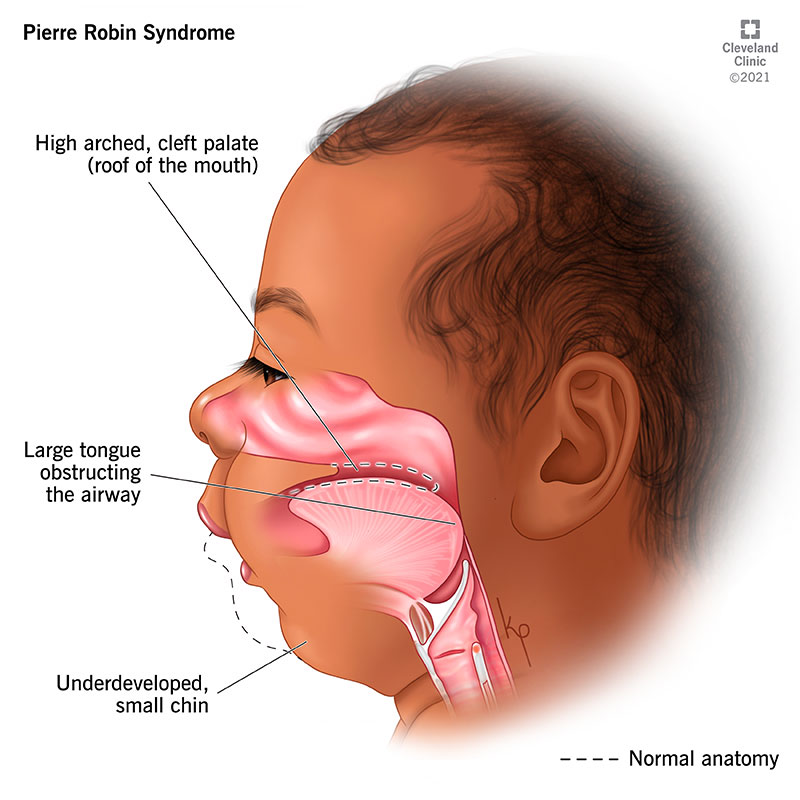
Image content: This image is available to view online.
View image online (https://my.clevelandclinic.org/-/scassets/Images/org/health/articles/21863-pierre-robin-syndrome)
Pierre Robin syndrome (PRS) — also called Pierre Robin sequence — is a condition in which your baby has a small jaw (micrognathia), a tongue that falls back toward the throat (glossoptosis) and upper airway obstruction. Infants with the condition also commonly have an opening in the roof of the mouth (cleft palate).
Advertisement
Cleveland Clinic is a non-profit academic medical center. Advertising on our site helps support our mission. We do not endorse non-Cleveland Clinic products or services. Policy
Pierre Robin syndrome is a congenital condition, meaning that it’s present at birth. PRS may occur alone or it may occur alongside a number of other conditions, including Stickler syndrome.
Pierre Robin syndrome is rare, occurring in approximately 1 out of every 8,500 to 14,000 people. The condition affects people of all genders equally.
Both Treacher Collins syndrome and Pierre Robin syndrome result in skeletal abnormalities of the head and face. While Treacher Collins syndrome affects the jaw, chin, ears and cheekbones, Pierre Robin syndrome primarily affects the jaw and oral structures.
Babies with Pierre Robin syndrome exhibit a wide range of symptoms that vary from case to case. Some of the most common symptoms of Pierre Robin syndrome include:
Advertisement
The exact cause of Pierre Robin syndrome is unknown. However, experts do know the sequence of events in the uterus that leads to the condition. It begins with an underdeveloped jaw, which causes the tongue to be displaced. As a result, a cleft palate may also develop, or the palate may have a high U-shaped appearance.
Not usually. Pierre Robin syndrome typically occurs in people who have no family history of the condition. Therefore, there is no known hereditary factor, although PRS can be found in syndromic conditions such as Stickler syndrome.
Your healthcare provider can diagnose PRS during a physical examination. Genetic testing can also help rule out other related health issues.
Treatment for PRS depends on the severity of the condition. Babies with mild Pierre Robin syndrome may need to sleep on their bellies instead of their backs to prevent the tongue from falling back and blocking the airway. (Be sure to talk with your healthcare provider before placing your baby in alternate sleeping positions.) If your baby has a moderate case of PRS, your healthcare provider may provide high flow air through a nasal tube or may place a tube through the nose and into the airway to allow for easier breathing. Severe cases of PRS require surgery to either create an opening in the airway or move the jaw into a more favorable position. This is called mandibular distraction and can improve feeding and breathing, which may help avoid tracheostomy in severely affected patients.
If your baby has been diagnosed with Pierre Robin syndrome, special care and attention must be given during feeding times to prevent liquids from going into the airway. In some cases, your healthcare provider may recommend a feeding tube to avoid choking.
The risk of choking may decrease once your child grows older and the lower jaw grows into a more typical size. Until then, the primary goal is keeping the airway clear. If your baby’s airway becomes blocked, several complications can arise, including:
Left untreated, Pierre Robin syndrome can be fatal. However, prompt treatment can ease your baby’s symptoms and improve overall quality of life.
In most cases, infants with Pierre Robin syndrome are evaluated by a medical professional shortly after delivery in the hospital. However, if you suspect that your baby has Pierre Robin syndrome, schedule a consultation with your healthcare provider immediately. Signs to watch for include choking problems, cyanosis (a condition that gives the skin a bluish hue) or high-pitched sounds when your baby breathes in.
Advertisement
A full understanding of your baby’s condition can help you make informed decisions regarding their health. Here are some questions to ask your healthcare provider:
Anytime your child is diagnosed with a health condition, it can feel overwhelming. Fortunately, Pierre Robin syndrome is usually treated successfully when detected early. Talk to your healthcare provider about treatment options. There are many resources available as well, including the American Cleft Palate-Craniofacial Association (ACPA) and Birth Defect Research for Children.
Advertisement



Delivered every Tuesday!
Sign up for our Health Essentials emails for expert guidance on nutrition, fitness, sleep, skin care and more
It's a letter about the news!
Every two weeks once
Sign up for our Health Essentials emails for expert guidance on nutrition, fitness, sleep, skin care and more.

Every day
Sign up for our Health Essentials emails for expert guidance on nutrition, fitness, sleep, skin care and more.
Learn more about the Health Library and our editorial process.
Cleveland Clinic’s health articles are based on evidence-backed information and review by medical professionals to ensure accuracy, reliability and up-to-date clinical standards.
Cleveland Clinic’s health articles are based on evidence-backed information and review by medical professionals to ensure accuracy, reliability and up-to-date clinical standards.