



More than 30 million people have chronic rhinosinusitis or CRS. Most people can be helped with medical treatment including antibiotics. Balloon sinuplasty might be a solution when your CRS symptoms last more than 12 weeks and medical treatment hasn’t helped.
Advertisement
Cleveland Clinic is a non-profit academic medical center. Advertising on our site helps support our mission. We do not endorse non-Cleveland Clinic products or services. Policy
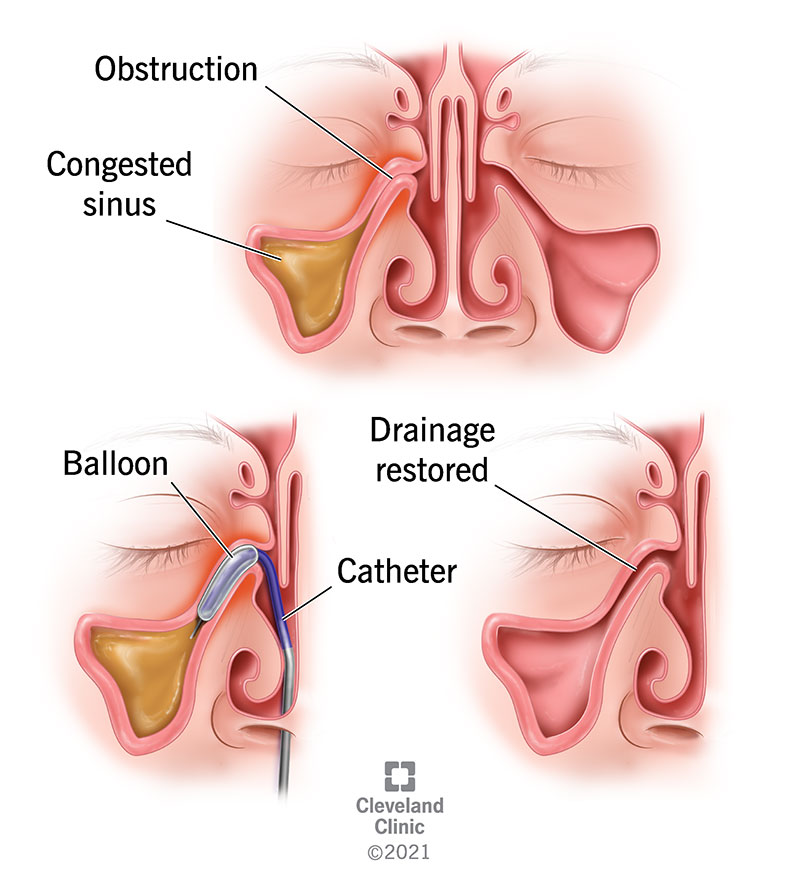
Image content: This image is available to view online.
View image online (https://my.clevelandclinic.org/-/scassets/Images/org/health/articles/21977-balloon-sinuplasty)
Balloon sinuplasty is a minimally invasive treatment for sinusitis, also called chronic rhinosinusitis (CRS). Some people who have chronic sinus symptoms may be treated with balloon sinuplasty instead of endoscopic sinus surgery (ESS).
Advertisement
Cleveland Clinic is a non-profit academic medical center. Advertising on our site helps support our mission. We do not endorse non-Cleveland Clinic products or services. Policy
More than 30 million people have chronic rhinosinusitis or CRS. Medical treatments, including antibiotics, can ease most peoples’ symptoms. But if your symptoms last more than 12 weeks, your healthcare provider might recommend balloon sinuplasty or endoscopic sinus surgery
CRS symptoms include:
Healthcare providers used balloon sinuplasty since 2005. The treatment has become increasingly popular as providers can perform the procedure at medical offices as well as hospitals.
Before you have balloon sinuplasty, your healthcare provider will use computed tomography (CT) scans to confirm balloon sinuplasty is an appropriate treatment for your condition.
Balloon sinuplasty can be done in a medical office or a hospital operating room.
If you’re being treated in an operating room, your balloon sinuplasty might include the following:
Advertisement
If you’re being treated in a medical office, your balloon sinuplasty might include the following steps:
No, balloon sinuplasty usually isn’t painful. Most people who have balloon sinuplasty report feeling a sense of pressure in their nose during the procedure.
You’ll stay at the hospital or medical office until you feel comfortable leaving. Most healthcare providers recommend you ask someone to drive you to and from your appointment. Your provider might recommend a potential schedule of follow-up appointments and tests:
Balloon sinuplasty is a safe and minimally invasive way to treat CRS. Studies show few people who have the procedure report side effects or complications.
While balloon sinuplasty has few complications, here are a few complications you might experience:
Your symptoms might come back, requiring additional procedures such as another balloon sinuplasty or a different treatment, such as endoscopic sinus surgery.
You might need to rest at home for 24 to 48 hours after your balloon sinuplasty. Your healthcare provider might recommend the following steps to help you recover:
Most people who have balloon sinuplasty notice some bloody drainage from their noses. That’s completely normal. Call your healthcare provider if your nose bleeds a lot and you can’t control the bleeding.
Advertisement
A nose that won’t stop running. Or a nose that is so stuffed with gunk that you can barely breathe. Or pain that makes your face ache. We’ve all had these sinusitis symptoms at one time or another. But if your symptoms last for more than 12 weeks, you don’t have to suffer — and sniffle — in silence. Tell your healthcare provider about your symptoms. They will recommend treatments that will help you breathe free again.
Advertisement



Delivered every Tuesday!
Sign up for our Health Essentials emails for expert guidance on nutrition, fitness, sleep, skin care and more
It's a letter about the news!
Every two weeks once
Sign up for our Health Essentials emails for expert guidance on nutrition, fitness, sleep, skin care and more.

Every day
Sign up for our Health Essentials emails for expert guidance on nutrition, fitness, sleep, skin care and more.
Learn more about the Health Library and our editorial process.
Cleveland Clinic’s health articles are based on evidence-backed information and review by medical professionals to ensure accuracy, reliability and up-to-date clinical standards.
Cleveland Clinic’s health articles are based on evidence-backed information and review by medical professionals to ensure accuracy, reliability and up-to-date clinical standards.